
How to Style a Phulkari Dupatta: Seven Ways to Wear the Craft
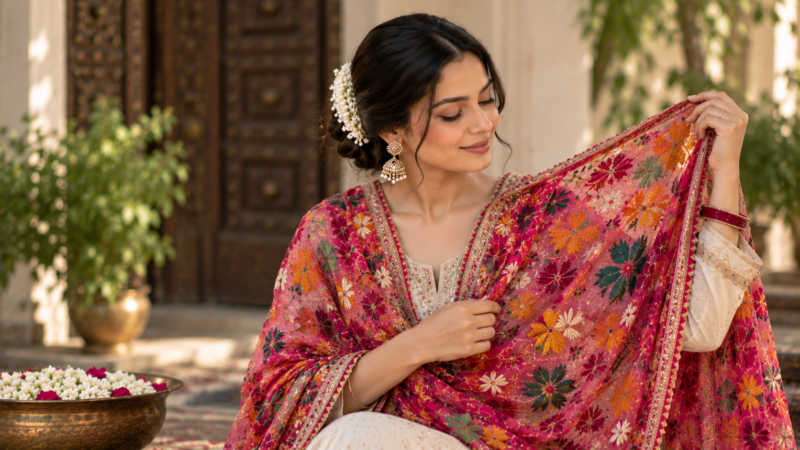
A Phulkari dupatta is usually kept for one day a year — folded into tissue after the wedding season, brought out only for the next one. That’s a waste of a piece that took a karigar weeks of needle-and-thread work to finish. Here are seven ways we send our own Phulkari dupattas out of the atelier, meant to be worn far more often than once.
Over a plain kurta, as the only statement piece
The easiest place to start. A solid cotton or khadi kurta — white, black, or a muted tone — lets a Phulkari dupatta in bagh or chope work carry the whole outfit. Skip other jewellery beyond a pair of jhumkas; the embroidery is doing the talking.
As a saree drape, not a dupatta
Phulkari dupattas are usually wide enough to wear pallu-first over a plain silk or cotton saree, embroidery side out. It reads as considerably more formal than a printed pallu, and works for anything from a Karva Chauth evening to a friend’s sangeet.
Belted, over a co-ord set
Fold it lengthwise, drape it like a stole, and cinch it at the waist with a thin belt over a matching kurta-pant set. This is the version that photographs best for daytime functions — mehendi, haldi, a Sunday brunch after the wedding season winds down.
Knotted at one shoulder, over denim
For anyone who wants the craft in a completely everyday context: a Phulkari dupatta knotted once at the shoulder over jeans and a fitted kurti. It’s how a lot of our younger customers in Chandigarh are actually wearing theirs outside of wedding season.
As a table runner or wall hanging, between wears
This one isn’t about wearing it at all — older or smaller Phulkari pieces, especially the geometric bagh patterns, work beautifully folded as a runner across a console table, or framed and hung. It keeps the embroidery visible instead of sitting in a cupboard for eleven months of the year.
Layered under a jacket, for winter functions
Chandigarh winters make this one practical: drape the dupatta first, then a fitted black or camel jacket over it, left open. The embroidery peeks through at the collar and hem — good for a daytime winter wedding function where a full ceremonial look would be too much.
As a dupatta, the traditional way — but with a modern blouse
Sometimes the classic combination is the right one. Where this changes is the blouse underneath: a structured, contemporary cut — a boat neck or a fitted collar — instead of a plain matching one, keeps the whole look from reading as costume.
A note on choosing one
Bagh (“garden”) patterns are dense, almost fully covering the base fabric — these read as bridal or occasion-wear. Chope patterns, worked mainly along the borders, leave more of the base cloth visible and drape more easily for everyday wear. If you’re buying your first piece to wear beyond a wedding, a chope dupatta in a single strong colour is the easier one to build a wardrobe around.
Every Phulkari dupatta at IZRA is hand-embroidered in Punjab and finished at our Chandigarh atelier. Browse the current collection or visit the Sector 17 studio to see the embroidery in person before you choose.
Browse the current collection for pieces referenced in this article.
Shop the Collection